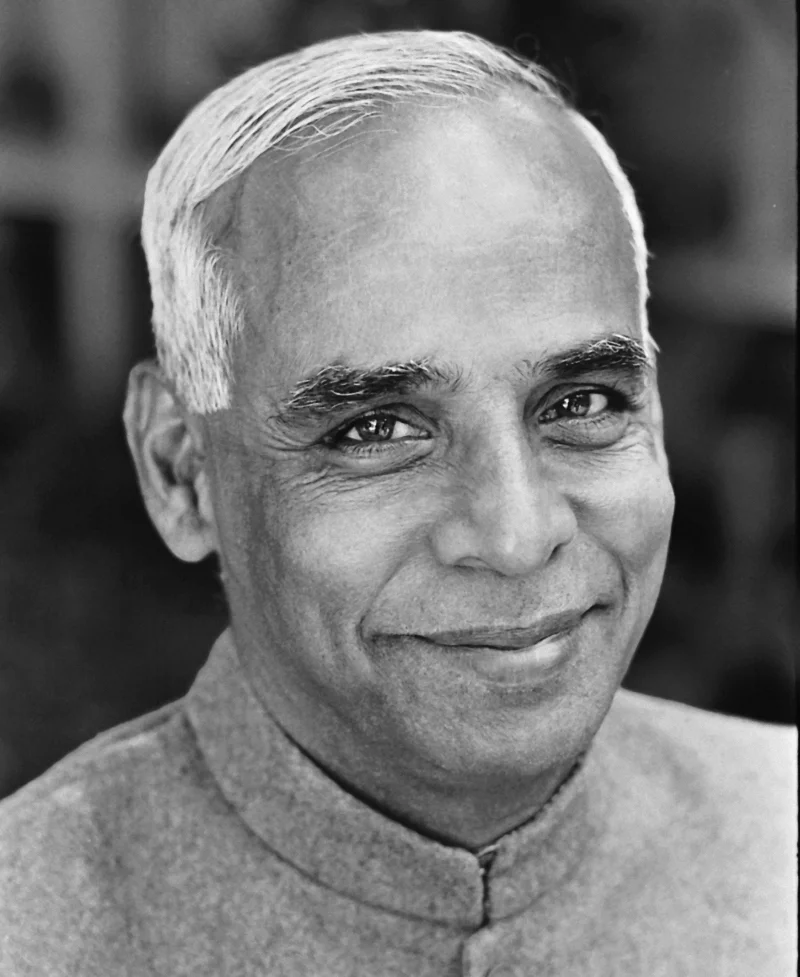
Easwaran: That’s a very helpful question. Today, I think, everyone knows there are physical and emotional benefits to meditation, particularly in relation to stress, which seems epidemic today. In addition, a lot of people have come to me with some serious personal problem, physical, emotional, or spiritual. Here meditation can help directly, and I am gratified to say that I have seen hundreds of students get over a serious problem and go on to lead very beneficial lives.
There is a second category – many of them artists, some of them scientists – who want to release deeper creative faculties that they feel are locked up within them. Everyone has these deeper resources, and here too meditation can help.
But there is a third kind of human being in every country: those who have come to the end of their material tether, who have played with all the toys of life and found that they cannot satisfy the hunger for meaning and purpose in their hearts. It touches my heart very deeply when they come and say, “We want to realize God.”
In all religions the mystics tell us: We are born, grow up, go to school, get jobs, grow old, and pass away even without knowing who we are. So the real purpose of meditation is, first and foremost, to enable everyone – in every country and every religion – to answer this question for oneself: “Who am I? What is my life for?”
When that question is answered,
it brings the realization that you are not separate from the rest of life. Then you feel at home everywhere. When
I came to this country, everyone warned me against culture shock. It took me just two hours to feel at home here, and that only because I had to get back my land legs after being so long at sea. Everybody on earth is really very much the same. Outwardly we look different, but when you see behind the physical mask – which is what the word personality signifies, from persona, a mask – you see that everyone is the same. This indivisible unity of life is the divine ground of existence by whatever term you call it.
From the Summer 2013 Blue Mountain Journal:
What are the signs of absorption in meditation?
Easwaran: First and foremost, you will begin to consider the joy of others a little more important than your own. That will probably begin with your family and friends and then extend
to your co-workers, but generally your sense of separateness from those around you will be less and less, so you identify with each of them more easily. And that will rub off on them too.
Secondly, your senses will gradually come more and more under your control. As you begin to look upon your body as a vehicle of loving service, for example, your motivation for eating will become very different.
In meditation itself, I can give
you a few little hints as to the signs of absorption. One of the earliest is that your senses slowly close down. You become so completely absorbed in the inspirational passage that there are no sounds, no distractions. As St. Teresa of Avila says, all the bees of the senses have come back to their hive and are sitting there quietly making honey. Sounds, though there may be a dim awareness of them, will seem at first as if they are coming from far, far away. Eventually you will not be aware of them at all. Other physical sensations, too, will cease to impinge on your consciousness. All this will be like writing on water; these distractions will not have any effect at all. You enter a stage of what I can only call quiet intoxication, in which the body feels almost as if it were not there. This is the beginning of the loss of body-consciousness: the burden of the body seems to have been lifted; the weight of the ego has been laid down.
Second, as you get absorbed, you are no longer dealing with distractions or with the problem of sleep in meditation. Where you used to fall asleep, now you’ve learned that the very wave of sleep that used to overcome you
can be ridden down into deeper consciousness just as a surfer does. When you see a wave of sleep coming from the depths of your consciousness, instead of lowering your head and succumbing, you can jump on the wave of sleep and keep awake, concentrated on the inspirational passage. Then you find that you’re not on the same old level of awareness; you have changed to a deeper level. Interestingly enough, you may feel greater pressure in your head at that level too, just as if you were diving deeper into the ocean.
(Incidentally, this conquest of sleep doesn’t come suddenly or by magic. There is a very difficult phase where at times, in spite of your best intentions, you fall asleep in meditation and are not even aware that you have fallen asleep. The way to break out of that stage is not during meditation only, but during the rest of the day. You go about being alert about your senses, not yielding to their tantalizing call. You look for opportunities to turn your back on self-will and repeat the mantram more; you become more particular about what you do before you fall asleep at night. This kind of vigilance will enable you to break through not only the last stages of the sleeping problem, but many of the other problematic stages as meditation deepens.)
Third, the inspirational passage slows down greatly, but the theme is still clear and the connection is still intact. Please make sure, when the inspirational passage slows down like this, that you’re able to keep the connection intact! Otherwise, meditation has not slowed down; it has stopped, leaving you in Alice’s Wonderland.
Eventually, at a certain great depth, your repetition of the words of the inspirational passage will do away with subject-object duality entirely – just for half a minute or so, just “the span of an Ave Maria.” At that time it is almost as if you’re not reciting the words of the inspirational passage, but the words of the inspirational passage are reciting themselves.
This is a very poor attempt at explaining what cannot be explained, but these are some of the signs that absorption is slowly beginning. But make sure that you don’t let go of the inspirational passage, and that during the day you follow all these disciplines with sustained enthusiasm: repetition of the mantram, training the senses, and particularly, opening your awareness to the people around and not letting self-will or selfishness come in the way.
This period of absorption, on the one hand, is a very difficult time. On the other hand, it is terribly exhilarating. You’ll find attention trying to escape from your control in so many ways that vigilance and concentration are required every moment. You are changing from one level of consciousness, where all of us are conditioned to walk, to an unknown level where there are no landmarks that you are familiar with, and where you may find yourself at a loss how to harness the immense energy that is coming into your hands. It is essential that this energy be harnessed for a selfless purpose rather than for pleasing yourself. Fortunately, all the disciplines of the eight-point program count as a selfless purpose, so you can pour all your excess energy into walking with the mantram, selfless service, and generally putting others first.
Gradually, when the mind becomes still and the ego is reduced to its minimal size, a tremendous experience takes place: you lose your nexus with the past. It is not that you don’t remember the past, but there is no emotional entanglement. You can look upon mistakes in the past with detachment and compassion, which is a very necessary condition for all of us who are on the spiritual path. As detachment grows, we are released from the tyranny of the past; the link between us and our past is cut, and we look at past mistakes as we might watch others in a film.