Eknath Easwaran: The Goal of Life

This week we'd like to share the first part of an audio talk given by Eknath Easwaran in February of 1992. As we were looking for an audio excerpt for this week, the title of this talk, "The Goal of Life" immediately caught our eye – what an intriguing topic! In this talk Easwaran dispels some of the misunderstandings about spiritual living and urges us to make our lives a work of art, in which every trace of selfishness, anger, and fear has disappeared.

Easwaran-Speaking.jpg

Easwaran gave weekly public talks at a local church in Northern California. This picture shows one such talk near the time of the audio excerpt shared in this post.

We won't say much more – after all what can you add with a title like that? – but we do want to put the talk in context. In the fall of 1991, Easwaran had a serious health crisis, leading him quite close to death's door. This talk, given shortly after his recovery, opens with him remarking on the joy of returning to his teaching schedule. You'll notice that his speaking pace is quite slow, and though that may be difficult to listen to at first, we noticed that as we listened, our minds slowed down, and we relaxed as we focused on the talk.

Easwaran-1.jpg
Easwaran-2.jpg
Easwaran-3.jpg

This week we're sharing the first half of the talk, which is just over 15 minutes. We'd love to hear from you about your thoughts on the talk and listening experience. In the comments below, feel free to answer these questions or share any other thoughts you might have:

  • Was there a phrase or portion of the talk that stood out to you?
  • Was there anything specific about your listening experience that you'd like to share? 

Happy listening!

A Source of Inspiration: Spiritual Reading

Meet Sagar, a YA from Stockton, California. Sagar shares his thoughts on one of the best resources for YA meditators – Easwaran's books!

YA-Sagar.jpg

I have read most of Eknath Easwaran’s books, and I have drawn inspiration from all of them. It is very hard to say which are my favorites. I can imagine Sri Eawaran saying that liking and disliking is itself a samskara (Sanskrit meaning a rigid habit).  Even though I never met Sri Easwaran while he was alive, I have a very personal relationship with him through his books. This bond continues to grow over time. I have found that I draw new meaning each time I read Sri Easwaran’s books, even when I have read the same book before. Although the material from Sri Easwaran’s books is drawn from talks to close students from many years ago, I have found that the message in his books has stood the test of time and is more important now than ever.

I would like to reflect on a few of the books I’ve been inspired by. One of my favorites has been Passage Meditation, which is the introductory book about the eight-point program. It is a simple but profound book. One of my favorite quotes in the introduction describes this path of meditation as being similar to running a marathon. Sri Easwaran says, “It helps to know at the outset that you will be running a marathon in the program, not simply jogging once or twice around a track. It is good to be enthusiastic when you sit down for meditation the first morning; but it is essential to be equally enthusiastic, equally sincere, at the end of the first week, and the end of the first month, and for all the months to come.” At the outset, the expectation is set that the work ahead will be hard.

I really like that the instructions and tips in this book are practical for those living in the modern world, and easy to understand, even though difficult to practice. For example, in the chapter on Training the Senses, Sri Easwaran says, “We begin the training of the senses by  denying them things that injure the body. . . We put in all kinds of things that nutritionists – and plain common sense – tell us impair the body’s smooth functioning, mainly because they taste pleasant. We haven’t yet learned that the body’s needs should determine what we eat, not the appeal of the senses.”  Saying no to eating something which tastes very good but may harm the body in the long run is easier said than done. I have personally found this practice to be beneficial to me by enabling me to develop positive habits, including incorporating more whole grains, fruits, and vegetables into my diet. I also have been able to eliminate certain unhealthy foods; and set limits to control portion sizes, such as when eating at restaurants with few healthy choices, or with desserts at social functions.

Easwaran-Passage-Meditation.jpg
Easwaran-Mantram-Handbook.jpg
Easwaran-Making-of-a-Teacher.jpg

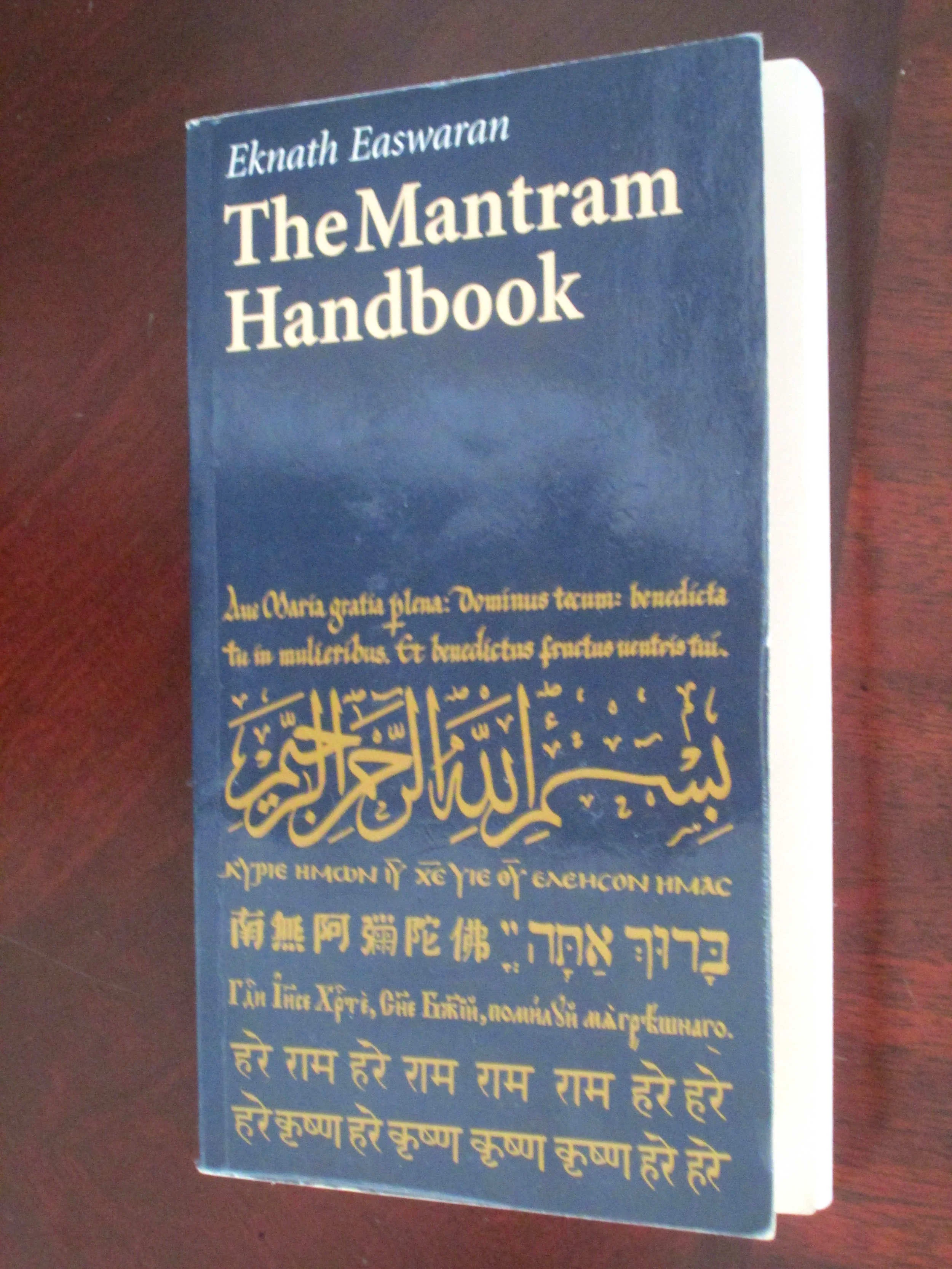
Another book which has been helpful to me is The Mantram Handbook.  Sri Easwaran says, “A mantram – or mantra, as it is often called – is a powerful spiritual formula, which, when repeated silently in the mind, has the capacity to transform consciousness. . . The mantram has appeared in every major spiritual tradition, West and East, because it fills a deep, universal need in the human heart.”  This book is of personal significance to me because my maternal grandmother from India from the Hindu tradition used to tell me often to repeat the mantram when I was young. Repetition of the mantram has become integrated into her daily routine.  I never really understood the meaning of her words until I read this book. The mantram can be practiced by anyone within or outside of a religious tradition and provides benefits in dealing with anger, reversing bad habits, worry, and other negative mental states. One of my favorite stories regarding the mantram is about a mahout giviving an elephant a bamboo stick to hold on to. Sri Easwaran says, “The elephant will walk along proudly with his head up high, holding the bamboo stick in front of him like a drum major with a baton.  He is not interested in bananas or coconuts anymore; his trunk has something to hold on to.” This simple practice can be used in so many different ways to help reduce agitation in the mind. Sri Easwaran very skillfully makes this practice accessible to a modern audience.

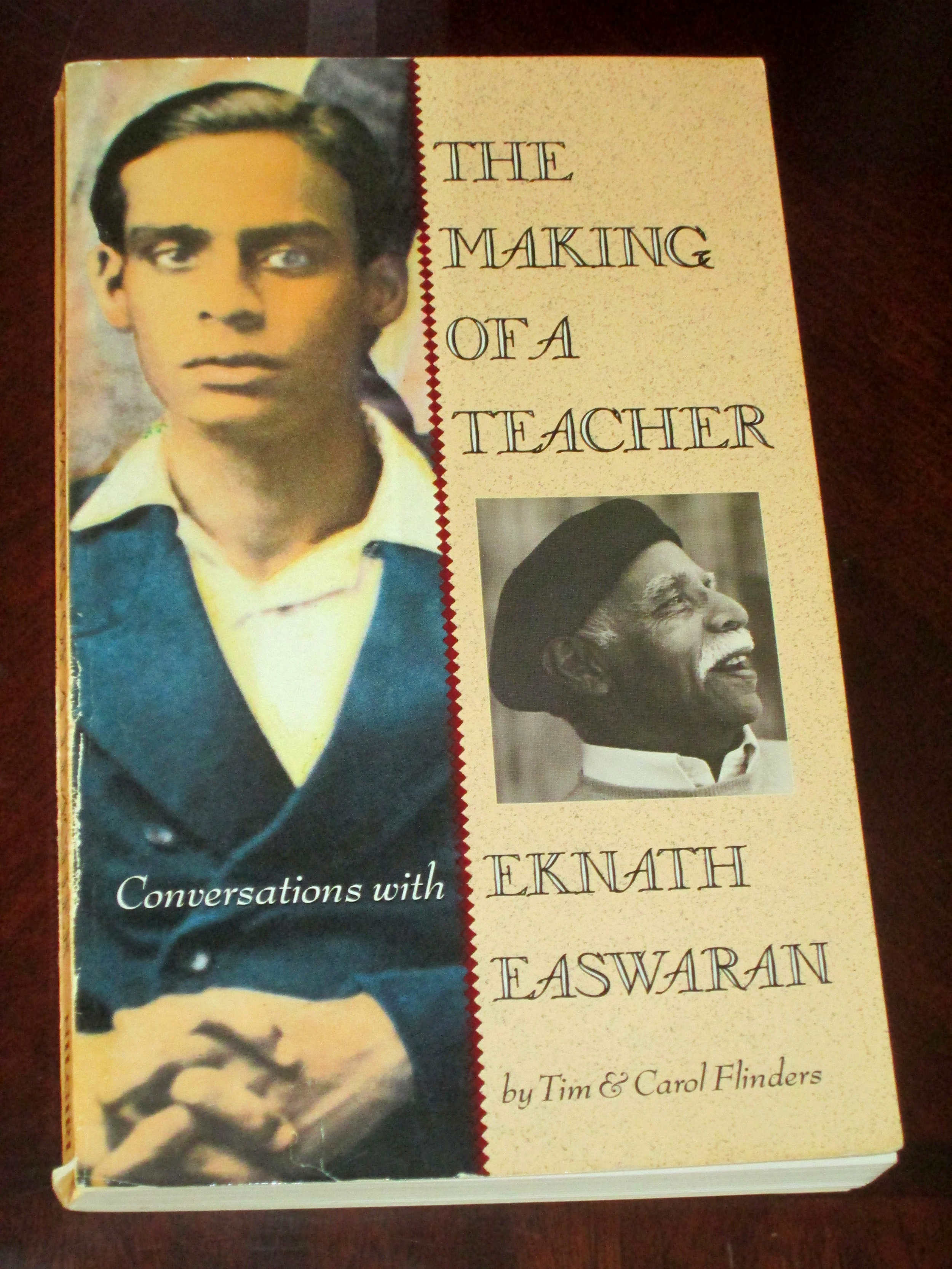
Among all the books, The Making of a Teacher, written by Sri Easwaran's long-time students, Tim and Carol Flinders, is unique in that it describes in detail Sri Easwaran’s early life before he came to the United States and became a spiritual teacher. It is fascinating for me to learn about the matriarchal culture in Kerala, India, in which Sri Easwaran was raised by his mother and grandmother. Although he mentions his own personal spiritual crisis which led him to start practicing meditation in other books, The Making of a Teacher covers this topic in more detail than any other book which I have read. It is very refreshing to know that my spiritual teacher did not renounce the world by going to a cave in the Himalayas but actually attained spiritual enlightenment in the midst of a busy working life. This fact makes it much easier for Sri Easwaran to relate to a modern audience. It also is interesting to read about the early days of the Blue Mountain Center of Meditation, including the first retreats when Sri Easwaran was the presenter.

The Classics of Indian Spirituality set includes translations of the Bhagavad Gita, Upanishads, and Dhammapada. I have found that these translations are very easy for the modern reader to understand. Although Sri Easwaran does not make a direct word-to-word translation of the scriptures, he is able to translate the heart of the message into easy-to-understand language. This series includes a comprehensive introduction for each book with background information about the scripture and the historical context of the scripture. The Bhagavad Gita for Daily Living series includes verse-by-verse commentary and has continued to be a source of inspiration. I feel that this series contains the sum of all of Sri Easwaran’s teachings.

Easwaran-Indian-Classics.jpg

Sri Easwaran’s books have been, and will continue to be, a source of inspiration in my life. Through his books, I have been enabled to make positive changes in my own life which are enduring and lasting. Sri Easwaran’s very personal writing style enables one to form a personal relationship with him, even though he is no longer physically present. I feel very blessed to have these resources available to me to help me in my own spiritual practice.

A Passage for February

36_small.jpg

After last month's brief detour, we're back to examining another passage, and we've picked out a favorite by Saint Teresa of Avila. The passages in the anthology God Makes the Rivers to Flow, chosen by Easwaran as ideal to meditate on, are indexed in a variety of ways: by title, by first line and, of course, by author and source. There is also a section offering background information on each author and source, showing the rich variety of experiences and traditions the passages represent. 

At a recent Bay Area YA Satsang day (check out a photo here), we did a reading study on the introduction to God Makes the Rivers to Flow and we were stunned! If you're ever in the need of a good boost, you should definitely read through this introduction – it's amazing. In addition to beautiful stories about how passage meditation works, Easwaran details the power of the passages. Here's a short excerpt from Easwaran's introduction:

The test of suitable meditation passages is simply this: Does the passage bear the imprint of deep, personal spiritual experience? Is it the statement of one who went beyond the narrow confines of past conditioning into the unfathomable recesses of the mind, there to begin the great work of transformation? This is the unmistakable stamp of authenticity. Only such precious writings can speak directly to our heart and soul. Their very words are invested with validity; we feel we are in the presence of the genuine.

Within this framework, we chose "Her Heart is Full of Joy" by Saint Teresa of Avila as our "passage of the month" for February. It's quite short, so if you don't have it memorized yet, we encourage you to add it to your repertoire and maybe we can all work it into our meditation rotation this month.

We'd love to hear from you in the comments below! Share your thoughts:

  • If we become what we meditate on, what might we become by meditating on this passage?
  • Is there a part of the excerpt from God Makes the Rivers to Flow that you found particularly striking?

Her Heart is Full of Joy – Saint Teresa of Avila

Her heart is full of joy with love, for in the Lord her mind is stilled. She has renounced every selfish attachment and draws abiding joy and strength from the One within. She lives not for herself, but lives to serve the Lord of Love in all, and swims across the sea of life breasting its rough waves joyfully.